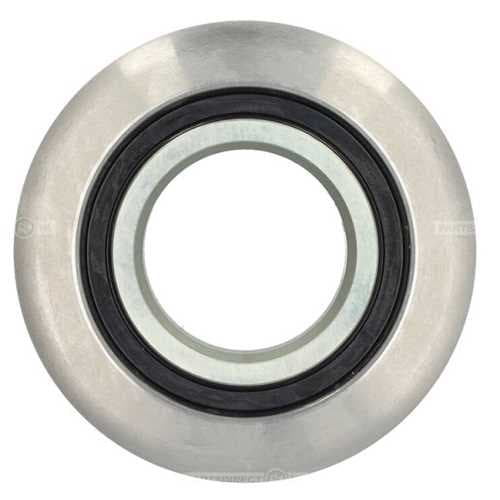
Almost every part on a forklift can be ordered by name. Mast rollers and chain sheave bearings cannot. They are specified by their dimensions, they change between mast variants on the same truck model, and the difference between the right part and the wrong one is often a few millimetres on a single face. This guide covers how to read the numbers, what end-of-life wear looks like, and what to send us so the first quote is the right one.
What the numbers mean
A mast roller or chain sheave bearing is normally written as three figures — for example 45×110×37. The convention is bore, then outer diameter, then width. The bore is the shaft it sits on, the outer diameter is the surface that runs in the mast channel or carries the chain, and the width is how thick it is. Measure bore and outer diameter with a caliper across the widest point, and take the outer diameter on an unworn section if you can find one: the running surface is exactly where material has been lost.
When the width figure is split
You will often see the width written as a pair — 40/31 — or with decimals, or with a fourth number appended. A split figure means the inner and outer races are not the same width, which is normal on mast and combined bearings: one race is captured by the shaft or a retaining shoulder while the other runs free. Both halves of that figure matter. A roller with the correct bore and outer diameter but the wrong race widths will either bind or sit proud in the channel. Send the string exactly as you measured or read it, decimals included — do not round 116.30 to 116.
Signs a roller is finished
Flat spots are the obvious one: a roller that has stopped turning slides instead of rolling and wears itself square on one side. Beyond that, look for play when you rock the roller on its shaft by hand, roughness or notchiness as you turn it, an outer race that has picked up a groove or a lip, cracked or spalled surfaces, and grease that has dried out or is coming away grey with metal in it. Check the mast channel while you are there — a scored channel will ruin a new roller, and worn shims or adjustment pads let the carriage rock and load the rollers unevenly.
Replace them as a set
Rollers work as a group. Replacing one on a carriage that has three worn ones simply moves the load onto the new part, and the mast will still rock. Change them per stage or per carriage, inspect the mast bushes, shims and adjustment pads while everything is apart, and set carriage clearance to the truck's specification afterwards rather than by feel.
What to send us for a quote
The fastest route to a correct quote is the truck's make, model and serial number, plus the mast type and lift height — mast components differ between mast variants on an otherwise identical truck. Add the measured dimensions of the old roller and a photo showing it both in place and off the shaft. We carry mast bearings, mast rollers, chain rollers, chain sheave bearings, mast bushes and adjustment shims for LINDE, TOYOTA, KOMATSU, MITSUBISHI, TCM, JUNGHEINRICH, STILL, HYSTER and DAEWOO trucks, along with universal-fit equivalents where the dimensions match. Send the details through our quote form and we will come back with what fits.