When an electric truck stops working, the motor is rarely the reason. Between the battery and the wheels sits a control circuit of contactors, switches and sensors, and almost every component in it is a wear part. They fail gradually, and in ways that look like something more expensive — which is why trucks get sent for motor work that a set of contacts would have fixed.
Before anything: isolate the truck
Disconnect the battery before opening a control panel, and on any truck with an electronic controller wait for the capacitor bank to discharge — it holds a charge after the battery is off. Treat suspected welded contacts as live: if the tips have fused, the truck can keep driving after the operator releases the control. That is the one failure mode in this circuit that hurts people rather than schedules.
Read the sequence, not the parts
The circuit works in an order, and the fault is usually where that order breaks: seat switch, key, brake or deadman, direction selector, then the contactor coil, then the main contacts. Ask what the truck does rather than what it fails to do. Nothing at all, no click, points upstream at an interlock — most often the seat switch. A clear click with no movement points at the main contacts. Chattering points at supply — a tired battery or a connection that cannot hold the coil in. Hydraulics running unasked point at a switch stuck closed.
What wears in a contactor
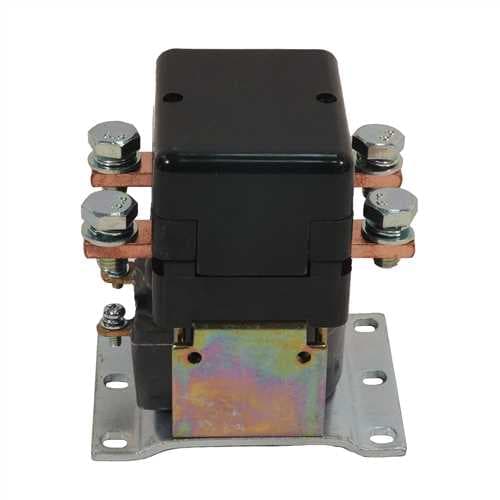
A contactor carries the full traction or pump current and makes and breaks it under load, so every operation erodes the tips a little through arcing. Blackening is normal on silver alloy; what condemns a set is lost tip thickness, deep pitting, or material transferred between the faces. The useful measurement is voltage drop across the closed contactor while the truck is working — a healthy set drops very little and stays cool, while a worn set drops volts and runs hot long before it fails outright. Filing modern tips is not a repair: it removes the plating. Coils fail separately, so a contactor that no longer pulls in is not automatically a contact problem.
Switches and speed control
Micro-switches sit in the seat, the brake, the direction lever and the hydraulic controls, and they fail either open, leaving the truck dead, or closed, leaving a function running. A truck that only works when a lever is held at an angle has a switch that is no longer actuated properly — as often a bent bracket or worn plunger as the switch itself. Accelerator potentiometers wear differently: the wiper spends most of its life at the idle end of the track, so that is where the track goes first. Surging at low speed, a dead band before the truck responds, or a truck that creeps is a worn track — sweep the resistance slowly with a meter and watch for dropouts.
What identifies the right replacement
For a contactor: coil voltage, continuous current rating, contact arrangement, terminal stud size and the mounting pattern. For a micro-switch: body format, actuator type, contact arrangement, electrical rating and terminal style. For a potentiometer: resistance value, number of tracks, the shaft or lever arrangement and the connector. A photograph of the part in place, mounted and wired, is worth more than any description.
Send us the truck, not just the part
Send the make, model and serial number of the truck along with the system voltage, the symptom and a photograph of the assembly, and we will confirm what fits before anything ships. We hold contactors, switches, potentiometers and control components in stock in Budapest for Linde, TOYOTA, Jungheinrich and Hyster trucks among other makes, deliver across Central Europe, and will come back to you with a quote.