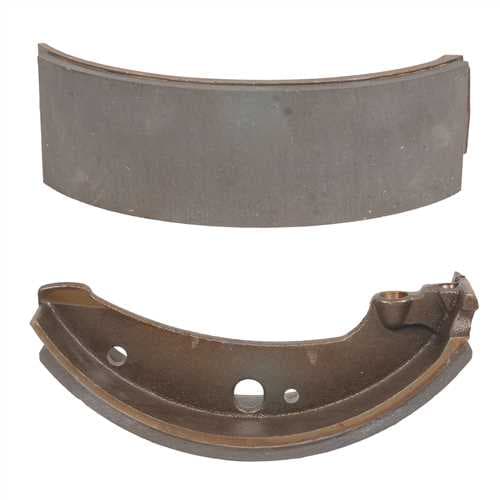
Brake shoes are among the most frequently replaced wear parts on a counterbalance forklift, and among the easiest to order incorrectly. Two trucks that look identical in the yard can carry different brake hardware, and a shoe that is a few millimetres out on drum diameter or lining width will never make proper contact. This is what our team works through before confirming a brake shoe for a customer's fleet.
Know when the shoes are due
The warning signs are usually gradual: longer stopping distances, a pedal that travels further before it bites, or a parking brake that no longer holds the truck on a loading ramp. Squealing or a metallic grinding under braking means the friction lining is at or past its limit and the drum itself is now at risk. Braking that pulls the truck to one side generally points to contamination or uneven wear rather than lining thickness alone. In a multi-shift operation, put brake inspection on a fixed interval rather than waiting for a driver to report it.
Match the drum, not just the model
A model designation on its own is rarely enough. The same model can be built with different axle and brake variants across production years, which is why the serial number matters. What settles it is the internal diameter of the drum, the width and thickness of the lining, the mounting and pivot arrangement of the shoe, and whether the lining is bonded or riveted. Measuring the old shoe and the drum bore and photographing both is faster than working from the data plate alone, and it catches trucks that have already been repaired with a non-standard part.
Replace in axle sets
Brake shoes should be replaced as a complete axle set, never one wheel at a time. A fresh lining working against a part-worn one on the opposite side produces uneven braking force and a truck that pulls under load, which is an avoidable handling risk in narrow aisles.
Inspect what sits behind the shoe
A new lining fitted into a scored, out-of-round or oversized drum will wear quickly and never reach full contact area. Check the drum surface together with the return springs, hold-down hardware and adjusters, since fatigued springs allow the shoe to drag. Look for hydraulic weeping at the wheel cylinder and for oil traces from a failing axle seal: a lining soaked in oil or grease must be replaced rather than cleaned, and the leak has to be fixed first or the new set will be contaminated within weeks.
Bed the new set in
New linings need a short break-in period before they deliver full performance. A series of light, controlled stops at low speed seats the lining to the drum, whereas heavy braking on the first shift glazes the surface instead. Re-check the brake adjustment and the parking brake after the first days of operation, once everything has settled.
Getting the right part first time
Send us the truck's brand, model and serial number, along with the drum diameter and lining dimensions if you are able to measure them, and we will confirm the correct brake shoe for that truck and come back to you with a quote. We supply brake shoes, drums, cables and hydraulic components for TOYOTA, Linde, Jungheinrich and Komatsu trucks among other makes, with stock in Budapest for delivery across Central Europe.